
Agentic AI vs RPA: Practical Differences, Real Use Cases, and How to Combine Them
Businesses are hitting a wall with their automation scripts. The robotic process automation tools that seemed revolutionary five years ago? They break every time a vendor updates their portal or moves a form field.
Meanwhile, a new approach called agentic AI is gaining traction—systems that can actually think, adapt, and make decisions instead of blindly following scripts.
This isn't just industry hype. The shift from rigid automation to adaptive, goal-driven systems represents a fundamental change in how enterprises handle work that requires judgment.
But here's what most comparisons miss: the real value doesn't come from picking one technology over the other. It comes from understanding exactly where each excels and combining them intelligently.
Let's be clear about terms before going deeper.
Robotic process automation (RPA) is software bots that mimic human clicks and keystrokes—think of them as very precise macro recorders. Agentic AI is different. It's goal-driven, powered by large language models, and can interpret context, make decisions, and adapt based on results.
This post covers the key differences between agentic AI and RPA, their distinct architectures, concrete use cases for each, and practical guidance on when to deploy them separately or together. The focus is on real-world examples and decisions, not abstract theory.
Quick Summary: Key Takeaways About Agentic AI vs RPA
RPA is deterministic and script-based. It's best for repetitive tasks with high volume and predictable inputs—invoice posting, payroll runs, and data migration between legacy systems.
Agentic AI is goal-driven and adaptive. It can reason over unstructured data like emails, PDFs, and chat transcripts while adjusting to changing conditions.
Agentic AI won't "kill RPA." Most enterprises will end up with hybrid automation that combines RPA bots, AI agents, and human oversight.
By 2028–2030, analysts expect a significant share of enterprise platforms (ERP, CRM, HR systems) to embed agentic capabilities while still relying on RPA for structured workflows.
The rest of this post will help you choose the right mix of RPA and agentic AI for your own business processes.
Why does this matter? Because the wrong choice wastes resources. Deploy RPA where you need reasoning, and you'll drown in exceptions. Deploy agentic AI where simple scripts would work, and you're overcomplicating the solution.
What Is RPA? (Robotic Process Automation)
Robotic process automation represents software robots that replicate human interactions with digital systems. These bots observe how people click through applications, fill forms, and move data between systems—then they do the exact same thing automatically.
Think of RPA as a digital worker that never gets tired, never makes typos, and works around the clock. Need to copy order data from emails into your ERP? Reconcile thousands of bank statements? Generate weekly reports from a legacy system? RPA handles it.
RPA works best with structured data in stable environments. Tables with consistent columns, fixed form fields, and processes where the steps rarely change—these are where RPA bots thrive. The technology excels when inputs are predictable and standardized.
RPA delivers speed on high-volume repetitive processes that would take humans hours to complete manually.
Organizations see significant error reduction in data entry and cross-system updates, as bots execute tasks with perfect consistency. The technology generates compliance-friendly audit trails documenting every action taken, which proves invaluable during regulatory reviews.
RPA also excels at working with older Windows applications and web portals that lack modern APIs, providing automation capabilities for legacy systems that would otherwise require costly replacements. Implementation timelines are relatively quick for well-defined, rule-based tasks, allowing organizations to realize value within weeks rather than months.
The 2015–2024 period saw massive RPA adoption across banking, insurance, utilities, and telecoms. Platforms like UiPath, Blue Prism, and Automation Anywhere became standard tools for back-office automation. Many organizations treated RPA as their first wave of automation—a stepping stone before exploring more advanced AI technologies.
Limitations of Traditional RPA
Despite its strengths, traditional RPA hits real constraints that frustrate operations teams.
Brittleness to change: Move a button, rename a label, reorganize a dropdown—and the bot breaks. Every system update becomes a potential automation incident.
Inability to handle ambiguity: RPA cannot process unstructured data. Free-form customer emails, scanned invoices with inconsistent layouts, chat transcripts with varied phrasing—these require interpretation that rule-based systems cannot provide.
No learning capability: RPA bots don't improve over time. Every exception or new rule demands a human developer to update the underlying script. The same mistake happens indefinitely until someone manually fixes it.
Scaling complexity: Each new process typically needs its own bot design, testing, and deployment cycle. After automating dozens of workflows, organizations find themselves managing sprawling automation estates with significant governance overhead.
Growing maintenance costs: Initial ROI from RPA can be strong, but maintenance burden compounds. As processes evolve and systems update, the cost of keeping hundreds of bots functional often exceeds the original automation investment.
These limitations don't make RPA obsolete. They define its boundaries—and explain why enterprises are looking beyond scripts toward systems that can reason.
What Is Agentic AI?
Agentic AI refers to artificial intelligence systems that can set sub-goals, plan steps, call external tools, and adapt based on results. Unlike traditional automation that follows fixed scripts, agentic AI pursues outcomes through strategic reasoning and autonomous decision-making.
The distinction matters. AI agents are individual goal-driven units—a single agent might handle document classification or customer inquiry routing.
Agentic AI is the broader approach where multiple agents can work together, coordinating across systems and handoffs to complete tasks that previously required human judgment at every step.
Modern agentic AI is typically powered by large language models like GPT-4, Claude 3, or similar foundation models. These systems combine natural language understanding with the ability to invoke tools: APIs, databases, search engines, and yes—RPA bots when screen-based automation is needed.
Consider insurance claims. An agentic AI system reads submitted documents—no matter the format. It asks clarifying questions via email. It updates the CRM and policy systems. It checks historical claims for fraud patterns. And it escalates edge cases to human reviewers. All of this happens as part of one goal, not disconnected scripts.
Gartner projects that by 2028, a significant share of enterprise software will embed agentic capabilities. This isn't speculation about distant futures—it's already happening in 2024–2025 pilots across finance, healthcare, and customer service operations.
Core Principles: Agentic AI vs RPA
Here's the real difference: RPA follows rules. Agentic AI pursues goals.
RPA is deterministic and rule-driven. Every action follows explicit if-then logic. If invoice total exceeds $10,000, route to senior approver. If customer type equals "premium," apply 10% discount. The bot does exactly what it's told, exactly the same way, every time. Quality depends entirely on how well the original script was written.
Agentic AI is goal-driven. Given a desired outcome—"approve or decline this application"—the system decides which steps and tools to use. It can break a large goal into sub-tasks, determine ordering, and re-plan if a step fails or new information emerges.
RPA needs explicit step-by-step instructions. You must anticipate every scenario and code the appropriate response. Miss a case, and the bot fails or loops indefinitely.
Agentic AI adapts to context. It considers multiple data sources simultaneously—past interactions, document content, external signals—and adjusts behavior in real-time. When a workflow is delayed due to a supply chain disruption, agentic AI doesn't simply halt. It finds alternatives, adjusts timelines, or informs stakeholders.
A simple analogy helps: RPA is like following a precise recipe—measure exactly, follow each step in order, and you'll get consistent results. Agentic AI is like a chef who can improvise based on what's available in the kitchen, adjust seasoning to taste, and substitute ingredients when needed while still producing a great meal.
Architecture: How RPA and Agentic AI Are Built
Understanding the underlying architecture helps explain why these technologies behave so differently.
Classic RPA architecture is built for reliability. You've got a central control server that schedules and monitors bots. The bots themselves run on virtual machines or dedicated workstations. They automate through screen scraping and click simulation, though they can also use API connectors for systems that support direct integration. Developers map process steps using visual workflow designers, and the system captures detailed logs of every action for audit purposes.
This architecture assumes workflows are defined in advance. The focus is on reliably performing each scripted step, handling structured processes with precision.
Agentic AI architecture works differently. At the core is an LLM "brain" that interprets instructions and reasons about approaches. This connects to various tools—APIs, databases, RPA bots, and enterprise applications. Memory stores retain context from previous interactions, allowing the system to build on past conversations. Planners break goals into steps and adjust when obstacles appear. And orchestration layers coordinate multiple agents and human handoffs.
Popular frameworks from 2023–2025 include LangChain, AutoGen, CrewAI, Microsoft Copilot Studio, and OpenAI's Assistants API. These provide building blocks for creating agentic systems without starting from scratch.
The key architectural difference: RPA says "do these steps exactly." Agentic AI says "achieve this goal however you can."
Key Differences Between Agentic AI and RPA
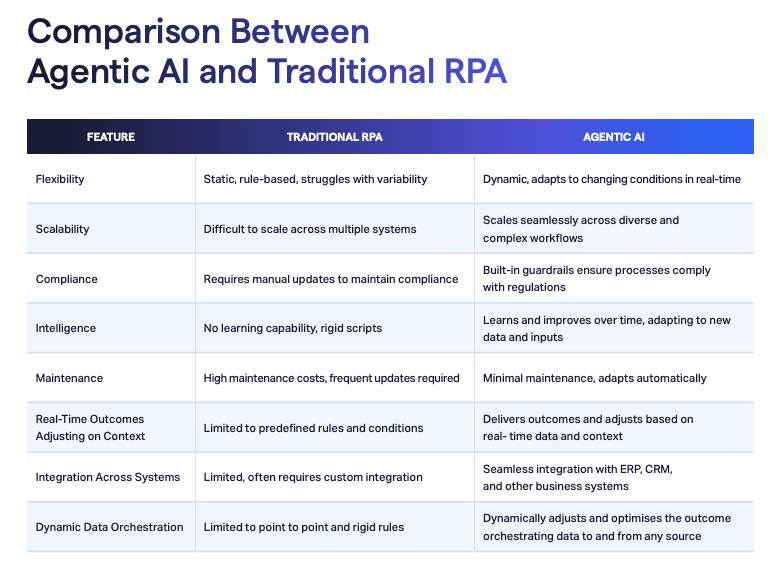
Unlike RPA, agentic AI excels at intelligent document processing where formats vary and interpretation is required. When customer queries arrive with attachments, an agentic AI system can analyze uploaded documents, extract relevant information regardless of layout, and route appropriately—while RPA would need every possible document format pre-coded.
This matters for operational efficiency. Complex processes with frequent exceptions consume disproportionate human time. Agentic AI addresses exactly these scenarios.
Typical Use Cases for RPA
RPA is still the right tool for specific automation patterns. Understanding where RPA excels helps avoid over-engineering solutions.
Back-office operations: Bulk invoice processing and posting to ERP systems works well with RPA. So does data migration between legacy databases during system transitions, payroll processing with structured inputs and defined calculation rules, end-of-day reconciliations in banking and financial services, and automated report generation from fixed data sources.
Front-office scenarios (still rule-based): Password resets following standard verification steps, account status lookups and balance inquiries, appointment scheduling from structured web forms, and order status updates from tracking systems all benefit from RPA's speed and consistency.
Industries with established RPA adoption: Finance and banking use it for account processing and compliance reporting. Insurance relies on it for claims data entry and policy administration. Utilities automate meter reading processing and billing. Telecoms handle service provisioning and billing adjustments. And the public sector processes benefits and permit applications.
Here's a mini case example: An accounts payable team processed invoices manually, taking three days on average from receipt to posting. After deploying RPA tools for data extraction from structured documents and automatic posting to their ERP, processing time dropped to hours. The key: invoices followed consistent formats from known vendors with stable data fields.
These use cases share common characteristics: clear rules, low ambiguity, high transaction volumes, and stable processes. When these conditions apply, RPA delivers strong ROI without the complexity of agentic systems.
Typical Use Cases for Agentic AI
Agentic AI handles the messy stuff—complexity, unstructured data, and constant change.
Enterprise automation scenarios: Triaging incoming support emails by reading full content, not just keywords. Summarizing lengthy contracts and flagging risky clauses for legal review. Orchestrating loan or insurance applications from intake through approval. Analyzing vendor contracts across thousands of documents with varied formats. Monitoring policy compliance across dynamic SaaS application landscapes.
Specific agent types emerging in 2024–2025 pilots: Invoice classification agents handle varied formats and extract data regardless of layout. Credit-processing agents evaluate applications with judgment about edge cases. Vendor analysis agents review contracts against internal policies. Customer service agents interpret context, not just keywords, to determine urgency.
Tool coordination capabilities: An agentic AI system can orchestrate multiple tools in a single workflow. Consider processing a complex customer request. The agent might call an OCR service to read an attached document, query the CRM for customer history, update the ERP system with new information, and chat with a human reviewer about an unusual case—all as part of completing one goal.
Customer-facing applications: Adaptive chat-based support can look up orders, interpret email attachments, understand sentiment and urgency, and escalate correctly—without hard-coding every possible conversation branch. This handles customer onboarding scenarios where documents vary and follow-up questions depend on what's submitted.
Orchestrating RPA bots: Agentic AI can decide when to trigger RPA automation. When an agent determines data needs to enter a legacy system that only supports screen interaction, it calls an RPA bot for that specific task—combining the strengths of both technologies.
Similarities: What Agentic AI and RPA Have in Common
Despite their differences, RPA and agentic AI share important characteristics.
Both aim to reduce manual effort, increase processing speed, and cut operational costs.
Both integrate with existing enterprise applications through APIs, connectors, or UI interaction.
Both require solid process understanding, documentation, and change management to succeed. Both produce logs and audit trails essential for compliance and continuous improvement.
Both are increasingly embedded into enterprise platforms (ERP, CRM, HR suites) rather than deployed only as standalone tools. And both need governance frameworks covering access control, monitoring, and incident response.
The implementation discipline required is similar: understand the process deeply before automating, define clear success metrics, and plan for ongoing maintenance.
Can Agentic AI Replace RPA?
Agentic AI won't kill RPA. In large organizations with legacy systems, you'll need both.
Technical reality: Some enterprise systems can only be automated through UI scripting. Older Windows applications without APIs, mainframe terminal interfaces, and proprietary portals often require RPA's screen-based approach. No amount of LLM reasoning changes that constraint.
Economic reality: RPA is often cheaper and simpler for narrow, stable tasks. Don't use agentic AI for straightforward data entry. A basic bot does the same thing cheaper. Agentic AI adds value where decisions and variability matter—not for routine tasks with predictable inputs.
Regulatory reality: In heavily regulated processes like payment execution in banking, deterministic RPA may remain the mandated approach. Regulators want to see exactly what happened and why, step by step. Agentic AI can assist with analysis and preparation, but the final execution often needs the predictability of scripted automation.
Practical timeline: For the next five to ten years, most automation strategies will assume a layered approach. RPA handles the execution layer—moving data, clicking through screens, posting transactions. Agentic AI operates at the decision and orchestration layer—determining what should happen, coordinating work, and managing exceptions.
Hybrid Automation: How Agentic AI and RPA Work Together
Hybrid automation represents the practical reality for most enterprises: AI agents orchestrate workflows while calling RPA bots, APIs, and humans as needed. This isn't theoretical—it's how organizations are deploying intelligent automation today.
Invoice processing scenario:
Traditional approach: RPA bots extract data from structured invoices and post to the ERP. But 20% of invoices have unusual formats, missing fields, or discrepancies that break the bot.
Hybrid approach: RPA bots handle the 80% of structured documents they can process reliably. An agentic AI system reviews the exceptions—interpreting varied layouts, validating ambiguous fields, checking for duplicate submissions, and identifying suspicious patterns. The agent decides what can be auto-resolved and what needs human review, then triggers appropriate RPA bots for final posting.
Customer onboarding in banking:
The AI agent collects submitted documents via email or portal, checks for completeness against requirements, and interprets varied ID formats and utility bills. When data is validated, the agent calls an RPA bot to input information into the core banking system (which only supports screen-based entry). Edge cases—unusual document types, potential fraud indicators, incomplete submissions—route to human reviewers with the agent's analysis attached.
Why this model works: Organizations keep their existing RPA investments productive while expanding intelligence and flexibility. The orchestration platform schedules bots, exposes APIs that agents can call, and maintains unified logging across both technologies. The agentic workflow coordinates everything without requiring humans to manage handoffs manually.
This is transforming enterprise automation from isolated task automation to coordinated process orchestration.
Risks and Limitations: Agentic AI vs RPA
Both technologies carry distinct risks that require proactive management.
RPA-specific risks: Brittle scripts break with system updates, creating maintenance burden. Mounting governance costs as bot estates grow into hundreds of automations. "Shadow automation" when business teams deploy bots without central IT oversight. Limited adaptability means changes require development cycles, slowing response to business needs.
Agentic AI-specific risks: Hallucinations where the system confidently produces incorrect information. Bias inherited from training data affecting decision quality. Compliance issues if autonomous AI systems make regulated decisions without proper oversight.
Data protection considerations: Agentic AI requires broader data access to reason effectively. An agent analyzing customer documents needs access to customer records, transaction history, and policy details. This raises privacy and security considerations requiring careful governance.
Explainability challenges: RPA steps are fully transparent—you can trace exactly what happened. Agentic AI reasoning may be harder to audit. Logs, approval workflows, and human review become crucial for high-stakes decisions.
Practical mitigation approaches: AI gateways control what agents can access and do. Clear role definitions specify each agent's scope and limitations. Staged rollouts with human-in-the-loop for new use cases. Monitoring dashboards track agent decisions and outcomes. Fallback procedures when autonomous AI systems encounter situations outside their defined boundaries.
Implementation Considerations and Best Practices
Whether you're deploying RPA, agentic AI, or both, the implementation principles are the same.
Before you pick a tool: Complete detailed process mapping to understand current workflows, handoffs, and exception patterns. Quantify the problem: how much time, how many errors, what's the cost of the status quo? Identify where human judgment is truly required versus where it's currently applied by default.
Setting clear outcomes: Define specific, measurable goals: reduce processing time by 40%, cut human errors by 60%, handle 3x volume without adding staff. Ensure metrics are trackable before and after implementation. Align automation goals with broader business objectives, not just task efficiency.
Governance frameworks: Establish access control policies for both bots and agents. Create change management procedures for updating automations. Implement monitoring for performance, errors, and unusual behavior. Define incident response procedures when automation fails.
Cross-functional collaboration: Include operations, IT, security, compliance, and business owners from design through rollout. Ensure process owners understand what's automated and what requires their input. Build feedback loops so improvements reach the automation team.
Pilot before scaling: Start with well-scoped use cases that have clear success criteria. Measure ROI rigorously before expanding to additional processes. Document lessons learned for subsequent implementations.
Real-World Example Scenarios
These scenarios ground the concepts in practical situations rather than vendor-specific case studies.
Finance: Accounts payable transformation
Before: RPA bots capture invoice data from PDFs and post to the ERP. Staff spend hours daily handling the 15% of invoices that fail—wrong formats, missing fields, duplicate submissions.
After: The same RPA bots handle structured workflows for standard invoices. An agentic AI system reviews exceptions, interprets non-standard formats, detects duplicates by analyzing content rather than just matching numbers, and flags suspicious suppliers based on pattern analysis. Human review focuses on genuinely ambiguous cases.
Customer service: Email handling
Before: RPA categorizes tickets based on keywords in subject lines and routes to queues. Customers sending complex requests get bounced between departments because the initial categorization missed context.
After: RPA still handles ticket logging and basic routing in the legacy system. An agentic AI agent reads full email bodies, understands the actual request, drafts appropriate responses for common issues, and routes complex cases to the right specialist with relevant context attached. Resolution time drops; customer satisfaction improves.
IT operations: Alert response
Before: Monitoring tools generate alerts. Staff review each one, decide if it's serious, then manually trigger remediation steps or document false alarms.
After: An agentic AI system watches incoming alerts, assesses severity based on historical patterns and current system state, triggers RPA bots to execute standard remediation (restart services, clear caches, gather diagnostic logs), and escalates genuinely novel issues to on-call engineers with analysis already completed.
Future Outlook: Automation Toward 2030
Observable trends from 2023–2025 point toward significant evolution in the automation landscape.
Platform embedding: Major software vendors are building both RPA-like actions and agentic capabilities directly into business applications. CRM systems offer built-in automation for repetitive HR tasks and customer workflows. ERP platforms include AI assistants that can reason about data and trigger actions. The distinction between "automation platform" and "business application" is blurring.
Analyst expectations: By around 2030, a substantial proportion of repetitive knowledge work will be partially automated through combinations of RPA, APIs, and AI agents. The manual copy-paste work that defined early automation targets is giving way to automated judgment calls, document understanding, and cross-system orchestration.
Regulatory influence: Emerging AI regulations (following patterns like the EU AI Act) will shape how agentic systems can be deployed in high-risk domains. Healthcare decisions, financial approvals, legal determinations—these may require deterministic RPA for execution even when agentic AI assists with preparation and analysis. This paradigm shift in governance keeps both technologies relevant.
Successful organizations are designing automation as an ecosystem—humans, RPA, and agentic AI working together—rather than betting everything on a single technology that promises to solve every problem.
Conclusion: Finding the Right Balance Between Agentic AI and RPA
RPA remains valuable for what it does well: executing structured tasks with predictable inputs at high speed and consistency. Invoice processing, payroll runs, data entry across legacy systems—these continue to benefit from scripted automation that works reliably without requiring AI reasoning.
Agentic AI unlocks capabilities that RPA cannot provide: interpreting unstructured data, adapting to changing conditions, coordinating complex processes that span multiple systems and require judgment. For dynamic workflows involving customer interactions, document analysis, or exception management, agents deliver what scripts cannot.
The best results come from integrating RPA and agentic AI rather than choosing one over the other. Use RPA to automate repetitive, stable execution steps. Use agentic AI to orchestrate workflows, handle exceptions, and make decisions that previously required human judgment. Let each technology do what it does best.
The question isn't "agentic AI vs RPA"—it's "where does each fit in your process landscape?" Start by auditing current processes. Identify high-friction areas where exceptions consume disproportionate time.
Map those areas to the right automation approach: RPA for the structured segments, agentic AI for the adaptive segments, hybrid approaches where both are needed.
Then start small. Pick one process with clear success metrics. Measure outcomes. Build evidence for what works in your environment before scaling to dozens of workflows.
Maintain governance and risk frameworks as you expand—the goal is sustainable automation that improves over time, not a fragile estate of bots that breaks with every system update.
