
Agentic AI vs. Generative AI: Stop Asking the Wrong Question
Stop asking if you should use Generative AI or Agentic AI. You’re asking the wrong question.
Generative AI is a powerful feature, but it’s not a strategy. It’s a creative assistant that still needs a human to tell it what to do, check its work, and connect it to your business systems. It’s a tool.
Agentic AI, on the other hand, is a workforce. It’s an autonomous system that doesn’t just create content, it manages entire business processes, end-to-end, directly within your ERP. This is the core of the agentic AI vs generative AI debate; one creates, the other does.
If you’re still thinking about AI in terms of content creation, you’re already falling behind. The real revolution is in process automation. This article breaks down the critical differences between agentic AI and generative AI, showing you where to focus your AI investment for actual business ROI, not just interesting outputs.
Understanding the agentic AI vs generative distinction is the first step.
What is Generative AI? The Creative Assistant That Still Needs a Boss
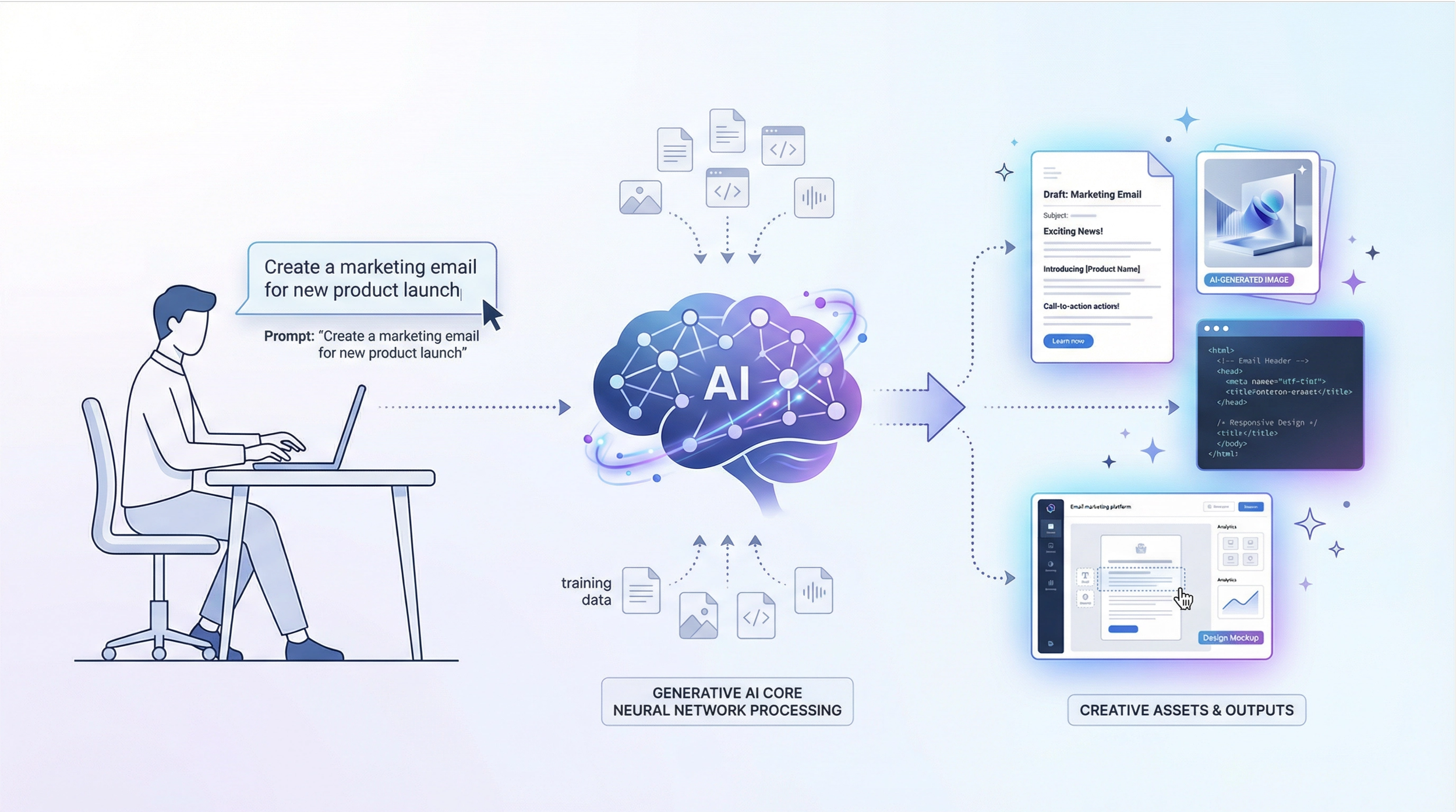
Generative AI refers to a class of artificial intelligence that creates new, original content by learning from vast amounts of training data. These popular AI systems, powered by large language models (LLMs), excel at producing human-like text, images, code, and audio.
When you use tools like ChatGPT or DALL-E, you are interacting with a generative AI model. The primary function of this type of AI is content creation. Generative AI generates output such as text, images, or code by identifying patterns in large datasets.
How Generative AI Works: A Reactive, Prompt-Driven Model
The defining characteristic of generative AI is its reactive nature. It requires constant human input to initiate its process. You provide a prompt, and the AI model, using patterns learned from its training data, generates a response.
This interaction is stateless; the AI doesn't retain memory or context from one request to the next unless specifically engineered to do so.
This is a key difference when comparing agentic AI vs generative AI. Generative AI operates on a single-step, prompt-response basis.
Generative AI excels at single-step tasks.
For example, a marketer can use gen AI tools to draft an email, a developer can generate a code snippet, or a designer can create a visual concept. However, a human must then take that output and integrate it into a larger workflow. The gen AI model doesn't know what to do with the email after it's written; it relies on human intervention to send it, track responses, and manage the follow-up sequence.
The Power and Limits of Generative AI Tools
There's no denying the power of generative AI tools. They have democratized content creation and augmented creativity in incredible ways. Generative AI accelerates the creation of high-quality personalized marketing materials and software development tools. The ability of generative AI to produce large volumes of SEO-optimized content is helping businesses drive organic traffic like never before. Generative AI is increasingly being integrated into various software and platforms to enhance user experience and provide intelligent functions.
However, it's crucial to understand their limitations. These AI models are not autonomous. They are powerful assistants that amplify human effort but cannot replace it. They are a component, not the entire machine. Generative AI makes decisions at a basic level based on statistical likelihood derived from training data. This is a critical point in the agentic AI vs generative AI discussion.
How Generative AI Adapts
Generative AI adapts by generating different styles of content. Based on the user's prompt and feedback, it can alter its tone, style, and format. This makes it incredibly versatile for creative tasks, but this adaptation is still confined to the realm of content. It doesn't change its strategy or goals, only the characteristics of its output. This is a fundamental point in the agentic AI vs generative AI comparison.
What is Agentic AI? The Autonomous Workforce That Owns the Outcome
Agentic AI represents a fundamental paradigm shift. Unlike generative AI, which is reactive, agentic AI is proactive and autonomous. An agentic system is designed to achieve specific, high-level goals with minimal human oversight. It’s not just about creating content; it’s about completing complex tasks and managing entire business processes from start to finish. This is where the agentic AI vs generative AI difference becomes a strategic advantage.
The Five-Stage Workflow of an Agentic System
Agentic AI systems operate through a sophisticated, continuous loop that allows them to manage complex workflows autonomously. This process can be broken down into five key stages:
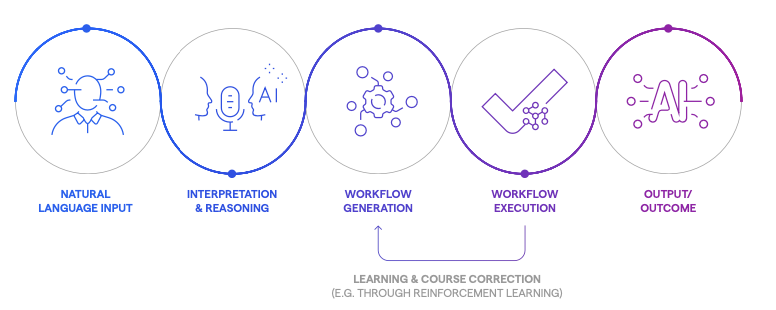
Natural Language Input: It all starts with a goal, often provided in natural language. This could be a high-level objective like "Reduce supply chain costs by 10%" or a specific instruction like "Monitor our top 5 competitors and report any price changes."
Interpretation & Reasoning: The agentic AI system analyzes the input, understands the intent, and begins to reason about the best way to achieve the goal. It breaks down the high-level objective into a series of smaller, manageable sub-tasks.
Workflow Generation: Based on its reasoning, the AI generates a dynamic, multi-step workflow. This isn’t a static, predefined process; it’s a flexible plan that can adapt to changing conditions.
Workflow Execution: The agentic AI executes the workflow, interacting with various tools, APIs, and systems to perform the necessary actions. This could involve anything from pulling data from an ERP system to sending an email to a supplier.
Output/Outcome: The system delivers the final output or achieves the desired outcome. This could be a detailed report, a completed transaction, or a fully optimized production schedule.
Crucially, this is not a linear process. A continuous feedback loop of Learning & Course Correction, often powered by reinforcement learning, allows the agentic system to adapt its strategy based on the results of its actions. If a particular approach isn’t working, the AI can adjust its workflow in real-time.
Deep Integration: The Key to Autonomous Action
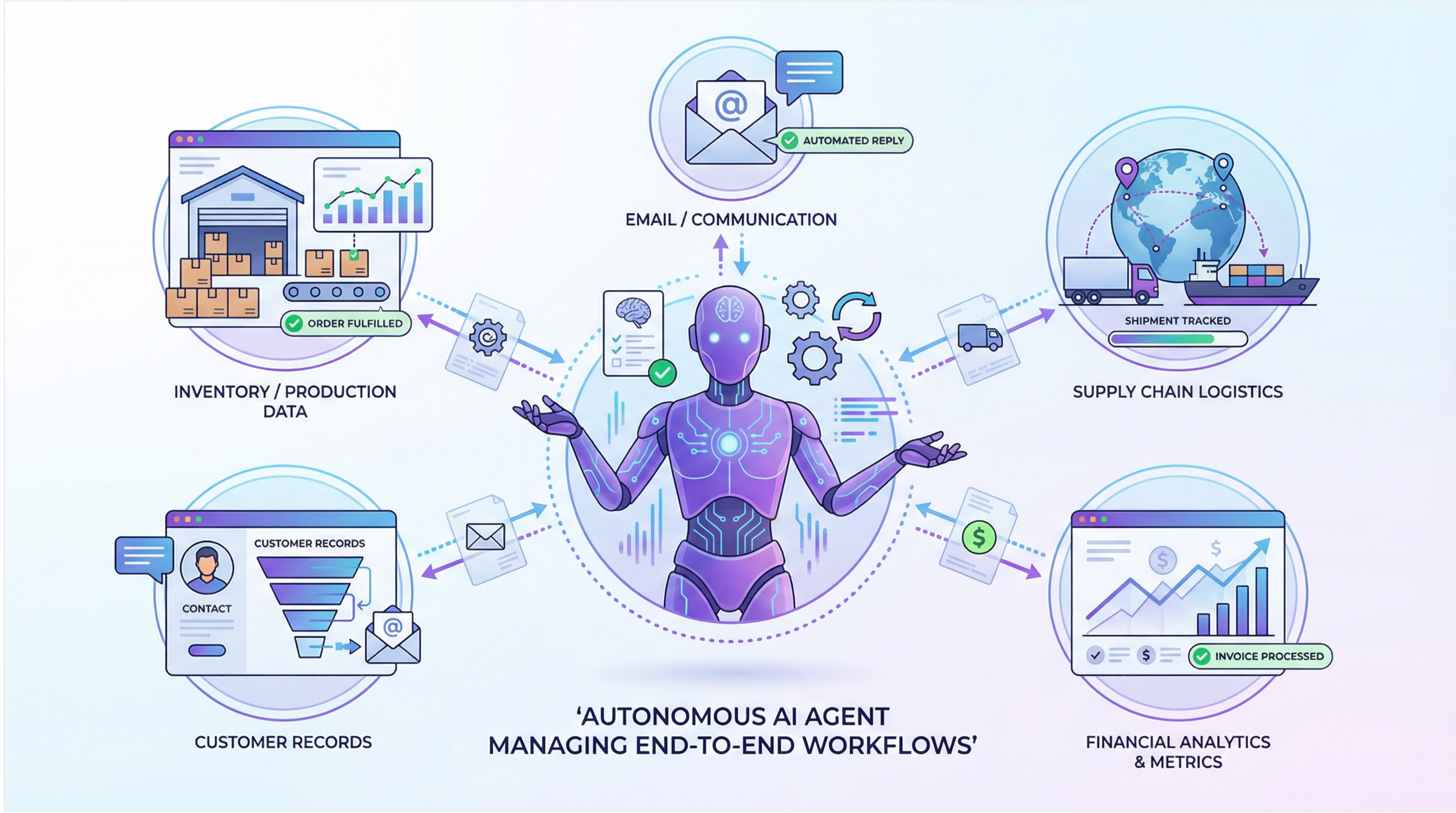
A key difference between agentic AI vs generative AI is integration.
While generative AI tools often operate as standalone applications, agentic AI systems are deeply integrated with the enterprise technology stack. They connect to your ERP, CRM, and other business systems, allowing them to not only access data but also execute actions directly within those platforms. This deep integration is what enables true workflow automation.
For example, an agentic AI system can automate internal workflows to make it easier on human employees without the need for their physical intervention. It can handle repetitive tasks like data entry, report generation, and invoice processing, freeing up human teams to focus on more strategic work.
Agentic AI can automate tedious tasks by gathering, cleaning, and formatting an organization's data, freeing human employees to focus on high-impact projects. This is a practical application of how agentic AI works to improve efficiency.
How Agentic AI Adapts
Agentic AI adapts by changing its strategy based on environmental feedback. If a supply chain is disrupted, an agentic AI can automatically reroute shipments. If a marketing campaign is underperforming, it can reallocate the budget to a more effective channel.
This ability to learn and adapt is what makes agentic AI so powerful for managing complex, dynamic business environments. Agentic AI can continuously analyze market trends and adjust strategies in response to economic changes.
Agentic AI vs Generative AI: A Strategic Comparison
To truly grasp the agentic AI vs generative AI distinction, it’s helpful to compare them across several key dimensions. This isn’t just a technical exercise; it’s a strategic one that will define your AI journey.
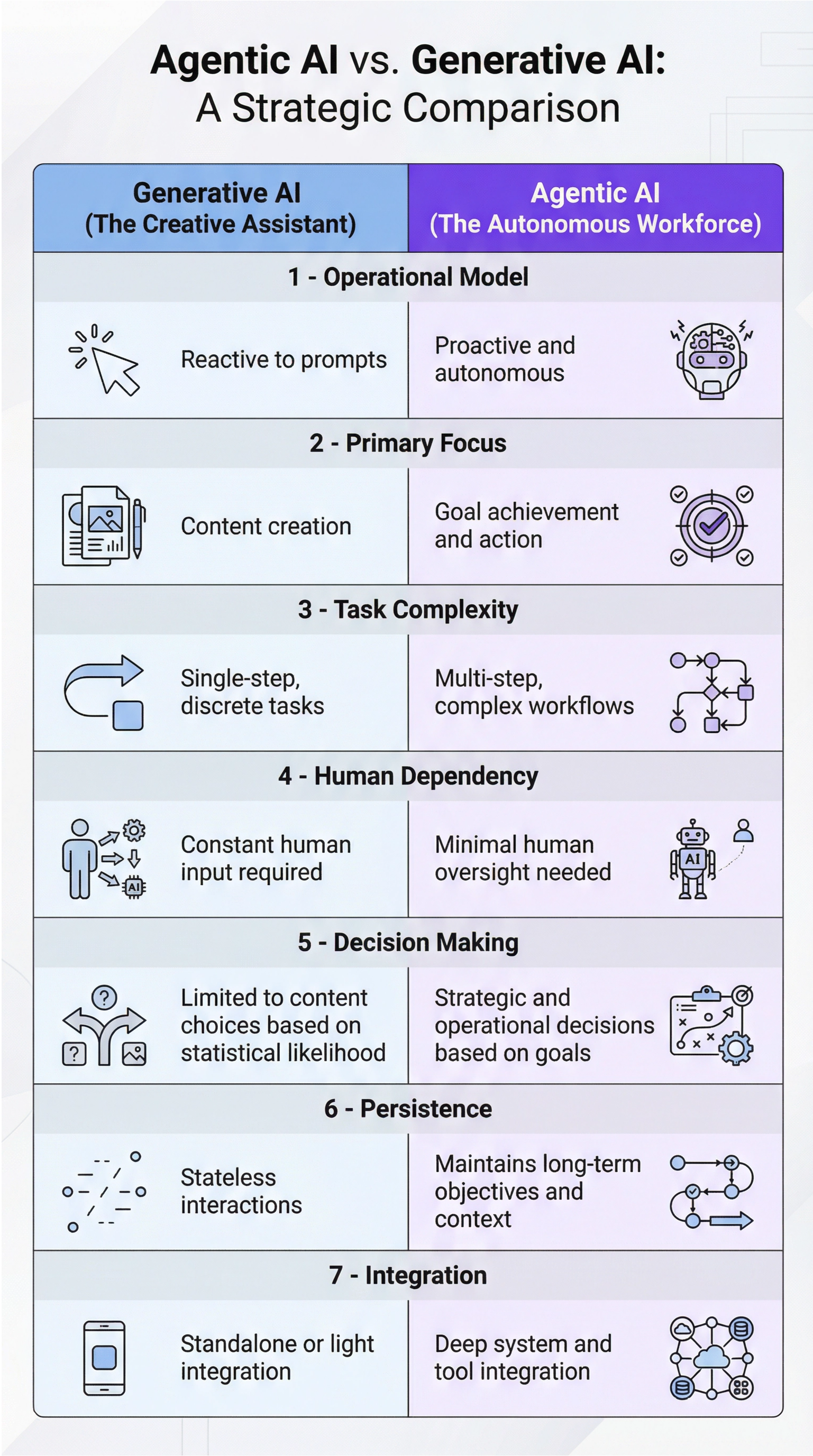
Autonomy and Decision-Making: The Core Difference
The most significant of the key differences between agentic AI and generative AI is autonomy. Generative AI operates with limited autonomy. It requires human creativity and direction for each task. An agentic AI, in contrast, demonstrates high autonomy. It can evaluate options, weigh trade-offs, and make strategic choices without constant human input. Agentic AI makes decisions to achieve a goal.
Real-World Applications: Where Each AI Technology Shines
Understanding the use cases for both agentic AI and generative AI is crucial for any business looking to leverage artificial intelligence.
Generative AI Use Cases: Augmenting Human Creativity
Content Marketing: Gen AI tools are used to create blog posts, social media updates, and email campaigns.
Software Development: Generative AI helps developers write code, debug, and create documentation.
Creative Industries: Designers and artists use generative AI for brainstorming and concept development.
Agentic AI Use Cases: Automating Core Business Processes
Financial Services: The financial services industry is expected to benefit significantly from agentic AI by optimizing trading strategies and analyzing market data. An agentic system can monitor markets 24/7, execute trades based on predefined parameters, and manage risk in real-time. Agentic AI can help industries meet client goals and optimize results in real-time by analyzing market trends and financial data to make autonomous decisions about investments and credit risks.
Supply Chain Management: Agentic AI can manage business processes autonomously and handle complex tasks like reordering supplies and optimizing supply chain operations. It can continuously monitor supply chains, predicting disruptions, adjusting routes, managing inventory, and coordinating with suppliers to maintain optimal flow.
Cybersecurity: Agentic AI can operate as an active defense layer, continuously monitoring systems and responding to threats in real time, containing breaches faster than human teams.
Healthcare: In healthcare, agentic systems can be embedded in smart devices to monitor patient conditions and environmental factors, alerting medical staff to critical changes.
Software Testing: Agentic AI can autonomously identify what needs testing, create comprehensive test strategies, execute tests across multiple environments, analyze results, and even self-heal when applications change.
Customer Service: Agentic AI can enhance customer service by automating responses and understanding user intent and emotional tone, allowing it to take proactive steps to resolve issues.
The Future is a Collaboration: Agentic AI and Generative AI Working Together
The ultimate power of AI is realized when agentic AI and generative AI work together. The integration of generative AI into agentic AI systems allows for more flexible and adaptive responses to user needs and environmental changes.
In this model, the agentic AI acts as the strategic brain and the workflow manager, while the generative AI acts as a specialized tool for communication and content creation.
Consider a customer service scenario. An agentic AI system can monitor customer support channels, identify an issue, and decide on the best course of action. It can then call upon a generative AI model to draft a personalized, empathetic email to the customer. The agentic AI then sends the email, tracks the response, and continues to manage the issue until it is resolved. This is the future of workflow automation.
Conclusion: From Content Creation to Process Automation
The agentic AI and generative AI debate isn’t about choosing one over the other. It’s about understanding the right tool for the right job. Generative AI is a revolutionary tool for augmenting human creativity and efficiency. But agentic AI is the strategic investment that will transform your business operations.
If you’re ready to move beyond simply creating content and start automating your core business processes, it’s time to explore the power of agentic AI. Learn how MyWave’s autonomous AI agents can integrate with your ERP and other business systems to drive real, measurable ROI. Schedule a Demo Today.
