
From Generative AI to Autonomous Agents: The Next Leap in Artificial Intelligence
The world of artificial intelligence has been buzzing for years, first with the rise of generative AI. We've all been amazed by its ability to create stunning images, write compelling text, and even generate code. But what if AI could do more than just create? What if it could act?
That's the core idea behind agentic AI. This isn't just a small upgrade; it's a massive leap forward. We're moving from AI systems that react to your prompts to agentic AI systems that can reason, plan, and execute tasks autonomously. The question on everyone's mind is: what is agentic AI?
Agentic AI refers to a new class of artificial intelligence designed to operate with a high degree of independence. These systems, powered by sophisticated AI agents, can take a high-level goal, break it down into smaller, manageable steps, and interact with the real world using various external tools. This incredible capability allows for minimal human intervention, fundamentally changing how businesses tackle complex tasks and complex workflows.
This post will unpack the power of agentic AI, show you how agentic AI works, and give you clear examples of how it's already transforming industries. We'll answer the four big questions: what is agentic AI, what's the difference between generative AI and agentic AI, is ChatGPT an agentic AI, and what is an example of agentic AI?
The Power of Agency: What Agentic AI Really Means
The Autonomous Difference: Beyond Traditional AI
Think of agentic AI as giving your AI agents the power of true agency, the capacity to act independently and with purpose to achieve a defined objective. Unlike traditional AI systems that are stuck in a loop of predefined rules, agentic AI systems are proactive. They don't just wait for your next command; they initiate actions, constantly monitor their environment, and adjust their plans to overcome any hurdles. Agentic AI incorporates a broader understanding of contexts and objectives compared to traditional AI, which is narrowly focused on specified tasks.
Creation vs. Action: A Brief Comparison
While both agentic AI and generative AI are powerful AI systems, they serve different purposes. Generative AI is a tool for creation, while agentic AI is a system for action. For a full breakdown of the differences, read our in-depth comparison: Agentic AI vs Generative AI: Stop Asking the Wrong Question.
Inside the Mind of an AI Agent: The Core Components
The foundation of any powerful agentic AI system is the AI agent itself. These are not the simple chatbots you're used to; they are intelligent, goal-driven software entities that mirror human-like problem-solving. Every AI agent operates through a sophisticated, continuous loop that can be broken down into five key stages:
Natural Language Input: It all starts with a goal, often provided in natural language. This could be a high-level objective like "Reduce supply chain costs by 10%" or a specific instruction like "Monitor our top 5 competitors and report any price changes."
Interpretation & Reasoning: The agentic AI system analyzes the input, understands the intent, and begins to reason about the best way to achieve the goal. Often powered by large language models (LLMs), this is the agent's "brain." It interprets the data, understands your human intent, and formulates a strategic plan. This is where AI agents learn and strategize their next move. The reasoning engine is what powers AI agents.
Workflow Generation: Based on its reasoning, the AI generates a dynamic, multi-step workflow. This isn't a static, predefined process; it's a flexible plan that can adapt to changing conditions. The agent formulates a plan, breaking the goal into a sequence of multi-step actions.
Workflow Execution: The agentic AI executes the workflow, interacting with various external tools, application programming interfaces (APIs), and external systems to perform the necessary actions. This could involve anything from pulling real-time data from an ERP system to sending an email to a supplier. The action module lets the AI agent execute tasks in the real world.
Output/Outcome: The system delivers the final output or achieves the desired outcome. This could be a detailed report, a completed transaction, or a fully optimized production schedule.
Crucially, this is not a linear process. A continuous feedback loop of Learning & Course Correction, often powered by reinforcement learning, allows the agentic system to adapt its strategy based on the results of its actions.
AI agents have both short-term memory (for the current task) and long-term memory (to store past interactions and learned knowledge), which is essential for continuous learning. This can be enhanced with techniques like Retrieval-Augmented Generation (RAG) to access proprietary data sources. If a particular approach isn't working, the AI can adjust its workflow in real-time.
How Agentic AI Works: The Cycle of Autonomy
The Power of Multi-Agent Collaboration
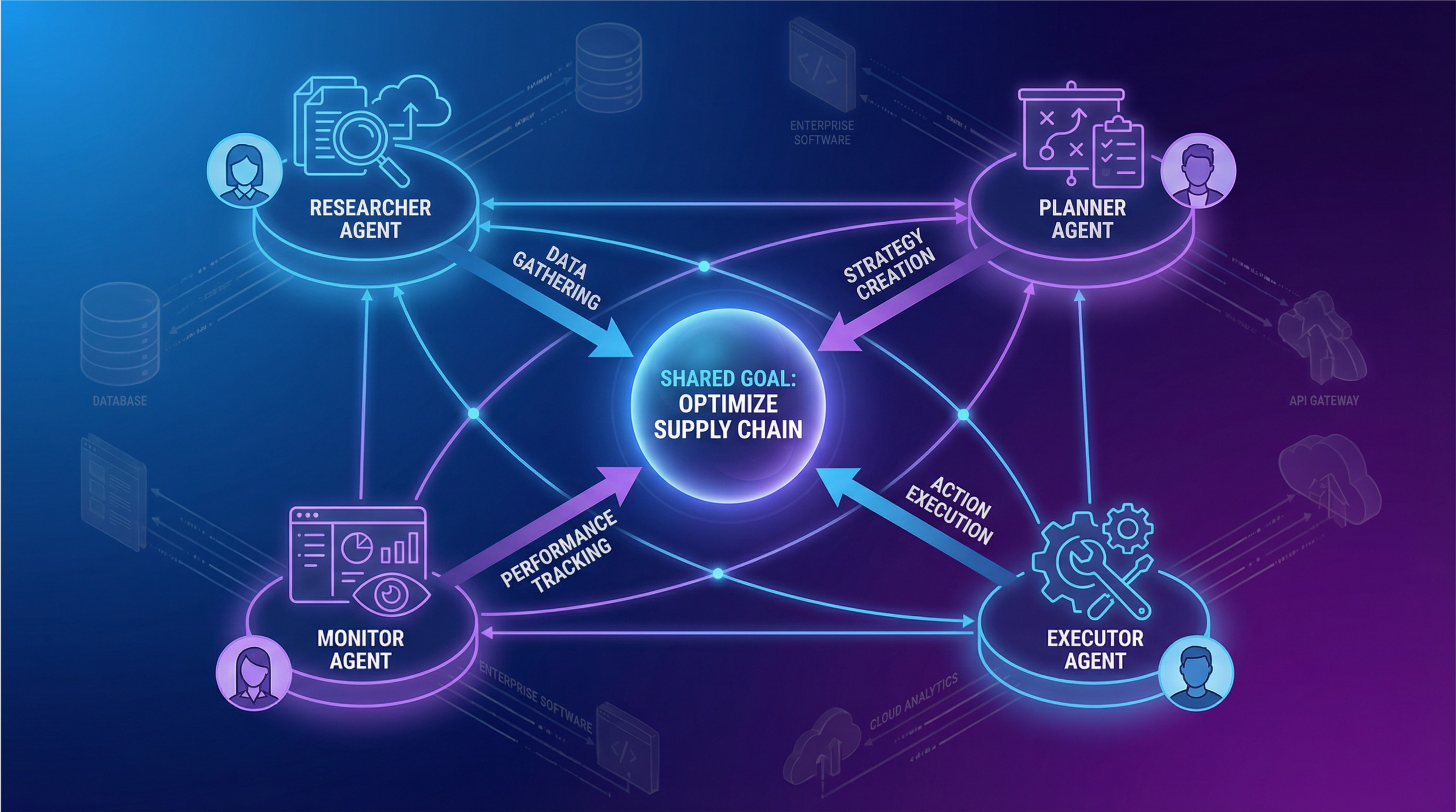
While a single AI agent can handle many complex tasks, the real game-changer in agentic AI is the multi-agent architecture. Multi-agent systems involve multiple specialized agents working together to achieve a single, overarching goal. In a multi-agent setup, you might have a "Researcher Agent" that uses external tools to gather information, a "Planner Agent" that sets the strategy, and a "Coder Agent" that uses generative AI to write and debug code. This is a core concept in advanced agentic systems.
This division of labor allows agentic AI systems to tackle incredibly complex problems and complex workflows that would be impossible for a single system. Multi-agent systems are the foundation for the most advanced autonomous AI systems being developed today. Agentic AI systems often include orchestration capabilities to manage how agents, robots, and humans collaborate across workflows.
Learning on the Job: Continuous Improvement
A key feature that sets agentic AI apart from traditional AI is its capacity for continuous learning. AI agents learn from the results of their actions. If an action fails, the AI agent analyzes the failure, updates its strategy, and tries again. This feedback loop, often driven by reinforcement learning and machine learning algorithms, ensures that the agentic AI system becomes more effective over time, requiring less and less human intervention and constant human oversight. Agentic AI continuously improves its performance through this process.
This ability to self-correct and improve means that agentic AI can thrive in dynamic, unpredictable environments, making them perfect for real-world applications like supply chain management and financial trading. Agentic AI systems rely on this learning mechanism to achieve true autonomy.
Benefits of Agentic AI: Real-World Use Cases
Adopting agentic AI is completely overhauling business processes by automating complex processes. We're not just talking about automating repetitive tasks (which is the job of robotic process automation); we're talking about AI-powered systems managing end-to-end processes.
Revolutionizing IT and Cybersecurity
Agentic AI is transforming IT support by proactively identifying and resolving issues before they escalate. Autonomous incident detection and root cause diagnosis are applications of agentic AI in IT and operations. For example, agentic AI can autonomously resolve complex IT tickets, verifying identities and approving necessary permissions.
In cybersecurity, agentic AI improves security by autonomously identifying and mitigating threats in real time. It facilitates real-time threat detection and adaptive threat hunting. An agentic system can simplify cybersecurity case management by automating the classification, tracking, and resolution of security incidents, performing continuous monitoring of network traffic and system logs.
Optimizing Financial Operations
In the financial sector, agentic AI is optimizing decision-making and automating complex processes by analyzing data in large volumes in real time. An AI agent can monitor market news, access data from trading platforms, perform predictive analytics, and autonomously execute trades to optimize a portfolio. This is a prime example of an autonomous ai agent at work, also applied in areas like fraud detection.
Enhancing Customer Support
Moving beyond simple AI chatbots, AI agents can handle customer service inquiries from start to finish. They can analyze the request, check the customer's account in external systems, diagnose the problem, and initiate a refund or service change, all without constant human supervision. This dramatically improves customer support and frees up human teams to focus on building stronger customer relationships.
Transforming Software Development
Agentic AI is changing the game in software development with "Dev Agents." These AI agents can function as a self-sufficient junior software engineer, creating development plans and writing code based on user stories. They can take a high-level natural language prompt (e.g., "Build a new user authentication module") and autonomously write, test, and debug the code. This is a huge step toward being able to automate complex tasks and significantly reduces the time spent on time-consuming tasks, allowing human teams to focus on innovation and solving complex challenges.
Streamlining HR and Administrative Tasks
Agentic AI is improving HR operations by automating routine administrative processes while providing real-time, personalized support for employees. This includes automating administrative tasks like onboarding, scheduling, and expense reporting, freeing up HR professionals to focus on strategic initiatives.
Your Top Questions About Agentic AI, Answered
What is the difference between AI and agentic AI?
The key difference lies in autonomy and proactivity. Traditional AI systems are typically designed to perform specific, narrowly defined tasks based on a given set of rules or data (e.g., classifying an image). Agentic AI extends this by adding a layer of autonomous goal-seeking behavior. Unlike traditional AI, an agentic AI system can create and execute a multi-step plan to achieve a high-level objective, interacting with its environment and adapting its strategy as it goes.
Is ChatGPT an agentic AI?
No, ChatGPT in its standard form is not an agentic AI system. ChatGPT is a perfect example of a generative AI model, a powerful large language models that excels at generating text. It is reactive and stops after generating its response. However, the technology behind ChatGPT (the LLM) is the "brain" used within an agentic AI system. When integrated with planning, memory, and the ability to call external tools, the LLM becomes the cognitive core of a powerful AI agent.
Is agentic AI LLM?
Not exactly. Agentic AI is a type of AI system, while a Large Language Model (LLM) is a component that often powers the reasoning part of that system. Think of the LLM as the engine and the agentic AI framework as the entire car, complete with a steering wheel (planning), wheels (actions), and GPS (goals). Agentic AI uses LLMs for their powerful natural language processing and reasoning capabilities but builds a much larger, more capable system around them.
What are examples of agentic AI?
A great example of agentic AI is an AI-powered personal travel assistant. You give it a simple natural language prompt like, "Plan a business trip to London next month, including flights, hotel, and a meeting with the marketing team." The AI agent would then:
Plan: Break the request into multi-step actions (search flights, book hotel, check calendar, send meeting invites).
Act: Use application programming interfaces (APIs) to search flight prices, book the best option, reserve a hotel, and send calendar invites to the marketing team.
Monitor: Track flight prices for a better deal and send you a notification if a cheaper option is found, demonstrating reinforcement learning.
Adapt: If the marketing team is unavailable, the AI agent would autonomously suggest alternative dates, all with minimal human intervention.
The Road Ahead: Challenges and Collaboration
The Trajectory of Autonomous Systems
The future of agentic AI is a world where AI agents are indispensable partners in every aspect of business processes. We are rapidly moving toward sophisticated multi-agent systems that can collaboratively manage entire organizations. Imagine a multi-agent system managing a factory, where one AI agent monitors machinery, another AI agent optimizes the production schedule, and a third AI agent manages the supply chain logistics. This level of autonomy promises massive gains in efficiency and the ability to manage complex processes with ease.
Navigating the Challenges of Implementing Agentic AI
While the potential is huge, implementing agentic AI comes with its own set of complex problems and challenges. The implementation of agentic AI can lead to challenges regarding accountability, data privacy, and the risks of excessive reliance on autonomous decision-making.
Safety and Control is paramount. We must ensure that AI agents always follow ethical guidelines and your human intent. This requires robust safety protocols and the ability to intervene quickly when needed.
Security is another critical concern. Because AI agents interact with external systems and access data, including proprietary data sources, they must be protected by robust security measures to prevent unauthorized access or manipulation.
Explainability is crucial for building trust. Understanding why an intelligent system made a particular decision allows organizations to validate outcomes and ensure proper governance. The reasoning process of these autonomous agents must be transparent, and we must ensure that specialized models used within the system are properly governed.
The Human-Agent Partnership
The rise of agentic AI is not about replacing human teams. Instead, it's about powerful augmentation. By automating repetitive tasks and time-consuming tasks, AI agents free up human agents to focus on creativity, strategic thinking, and high-level problem-solving. The most successful organizations will be those that master the art of collaboration between human agents and AI-powered systems, ensuring proper human oversight remains in place.
Conclusion: Embracing the Agentic Era
Agentic AI is more than just a buzzword; it's a fundamental shift that is redefining the capabilities of artificial intelligence. By combining the creative power of generative AI with the autonomous action of AI agents, we are entering an era where AI systems can tackle the world's most complex challenges with unprecedented efficiency.
From supply chain management to software development, agentic AI systems are proving their value by automating complex processes and achieving goals with minimal human intervention. The future is agentic, and it promises a world where AI agents are our most capable partners in innovation. Adopting agentic AI is the next logical step in any company's AI journey.
